Según una encuesta deGallupde septiembre de 2021, el 45 % de los empleados estadounidenses a tiempo completo trabajaban desde casa, incluido el 25 % que trabajaba desde casa todo el tiempo y el 20 % que trabajaba desde casa parte del tiempo.[18]
En 2020, el 12,3 % de las personas empleadas, incluido el 13,2 % de las mujeres y el 11,5 % de los hombres, en la Unión Europea que tenían entre 15 y 64 años, solía trabajar desde casa.Por país, el porcentaje de trabajadores que trabajaban desde casa era más alto en Finlandia (25,1 %),Luxemburgo(23,1 %), Irlanda (21,5 %), Austria (18,1 %) y los Países Bajos (17,8 %) y el más bajo enBulgaria( 1,2 %), Rumanía (2,5 %),Croacia(3,1 %), Hungría (3,6 %) yLetonia(4,5 %).[19]
En 2021, en los EE. UU., el 91 % de las personas que trabajan desde casa dijeron que les gustaría seguir trabajando de forma remota en el futuro.En el estudio de Gallup de septiembre de 2021, el 54 % de los trabajadores dijeron que creían que la cultura de su empresa no cambiaría con el trabajo remoto, mientras que el 12 % creía que mejoraría y el 33 % predijo que se deterioraría.
Según laOficina de Administración de Personal de los Estados Unidos, en el año fiscal 2020, el 50 % de todos los trabajadores federales de EE. UU. eran elegibles para trabajar de forma remota y las agencias ahorraron más de $180 millones gracias al trabajo remoto en el año fiscal 2020.[20]
Employees having inadequate equipment or technology can prevent work from getting done. A FlexJobs survey found 28% had technical problems and 26% reported WI-FI issues.[53]
Additionally, remote work may not always be seen positively by management due to fear of loss of managerial control.[100]
A study found that managers had a bias again employees who did not work in the office. Manager attributed the amount of time they saw an employee in the office more than the work than the contribution that was made.[55]
Isolation due to remote work also hinders formation of friendships.[95][26]
Although several scholars and managers had previously expressed fears that employee careers might suffer and workplace relationships might be damaged because of remote work, a 2007 study found that there are no generally detrimental effects on the quality of workplace relationships and career outcomes. Remote work actually was found to positively affect employee-supervisor relations and the relationship between job satisfaction and turnover intent was in part due to supervisor relationship quality. Only high-intensity remote work (where employees work from home for more than 2.5 days a week) harmed employee relationships with co-workers, even though it did reduce work-family conflict.[31][32]
Individuals may differ in their reactions to the job characteristics in remote work. According to job characteristics theory, the personal need for accomplishment and development ("growth need strength")[62]influences how much an individual will react to the job dimensions of remote work. For instance, those individuals high in "growth need strength" will have a more positive reaction to increased autonomy and a more negative reaction to decreased feedback in remote work than those individuals low in "growth need strength".
A 2021 report from Prudential found that the majority of people prefer the hybrid model, and that two in three workers believe in-person interactions are important for career growth. The report also found that fully remote workers felt less entitled to take a vacation and believed they must be available around the clock. One in four workers felt isolated, and reported this as a major challenge. Ultimately, most workers want flexibility but do not want to give up the benefits available from working in-person with colleagues.[96]
Communication and getting to know other teammates happen naturally when everyone works in the same space, so with remote work, employees and supervisors have to work harder to maintain relationships with co-workers. This is especially important for new employees so that they learn organizational habits even when working remotely.[88]
Three of the five job attributes: skill variety, task identity, and task significance, influence how much employees think their jobs are meaningful.[63]Skill variety is the degree of activities and skills that a job requires in order to complete a task. An increase in skill variety is thought to increase the challenge of the job. Increasing the challenge of the job increases the individual's experienced meaningfulness, how much the individual cares about work, and finds it worthwhile.[89][63]Remote work may not directly affect skill variety and task meaningfulness for the individual compared to when he or she worked in an office; however, skill variety and meaningfulness of individual tasks can increase when working in a group. If the work done at home is focused on the individual rather than the team, there may be fewer opportunities to use a variety of skills.[76]
Task identity is the degree that the individual sees work from beginning to end or completes an identifiable or whole piece of work rather than only a small piece. Task significance is the degree that the individual feels his or her work has a substantial impact on the lives or work of other people within the organization or outside the organization.[63][76]Remote work may not change the job characteristics of skill variety, task identity, and task significance compared to working in an office; however, the presence of these characteristics will influence remote workers' work outcomes and attitudes.
In his book, "Together: The Healing Power Of Human Connection In A Sometimes Lonely World,"U.S. Surgeon GeneralVivek Murthyasserts that face-to-face meetings, in-person collaboration, and "micro-moments" of community at work are what give people the essential feeling ofbelongingnessand being part of a team.[90][91]
Hi tattoous1.blogemailing2@blogger.com, tattoous1@gmail.com added you to the 1top-oldtattoo-1 group.
Google Groups allows you to create and participate in online forums and email-based groups with a rich community experience. You can also use your Group to share documents, pictures, calendars, invitations, and other resources. Learn more.
AM processes for metal sintering or melting (such as selective laser sintering, direct metal laser sintering,
and selective laser melting) usually went by their own individual names
in the 1980s and 1990s. At the time, all metalworking was done by
processes that are now called non-additive (casting, fabrication, stamping, and machining); although plenty of automation was applied to those technologies (such as by robot welding and CNC), the idea of a tool or head moving through a 3D work envelope transforming a mass of raw material
into a desired shape with a toolpath was associated in metalworking
only with processes that removed metal (rather than adding it), such as
CNC milling, CNC EDM, and many others. But the automated techniques that added
metal, which would later be called additive manufacturing, were
beginning to challenge that assumption. By the mid-1990s, new techniques
for material deposition were developed at Stanford and Carnegie Mellon University, including microcasting[31] and sprayed materials.[32] Sacrificial and support materials had also become more common, enabling new object geometries.[33]
The term 3D printing originally referred to a powder bed process employing standard and custom inkjet print heads, developed at MIT by Emanuel Sachs in 1993 and commercialized by Soligen Technologies, Extrude Hone Corporation, and Z Corporation.[citation needed]
The year 1993 also saw the start of an inkjet 3D printer company initially named Sanders Prototype, Inc and later named Solidscape,
introducing a high-precision polymer jet fabrication system with
soluble support structures, (categorized as a "dot-on-dot" technique).[25]
The Fused Deposition Modeling (FDM) printing process patents expired in 2009.[34]
This opened the door for a new wave of companies, many born from the
RepRap community, to start developing commercial FDM 3D printers.
2010s
As the various additive processes matured, it became clear that soon metal removal would no longer be the only metalworking
process done through a tool or head moving through a 3D work envelope,
transforming a mass of raw material into a desired shape layer by layer.
The 2010s were the first decade in which metal end use parts such as
engine brackets[35] and large nuts[36] would be grown (either before or instead of machining) in job production rather than obligately being machined from bar stock
or plate. It is still the case that casting, fabrication, stamping, and
machining are more prevalent than additive manufacturing in
metalworking, but AM is now beginning to make significant inroads, and
with the advantages of design for additive manufacturing, it is clear to engineers that much more is to come.
One place that AM is making a significant inroad is in the aviation industry. With nearly 3.8 billion air travelers in 2016,[37]
the demand for fuel efficient and easily produced jet engines has never
been higher. For large OEMs (original equipment manufacturers) like
Pratt and Whitney (PW) and General Electric (GE) this means looking
towards AM as a way to reduce cost, reduce the number of nonconforming
parts, reduce weight in the engines to increase fuel efficiency and find
new, highly complex shapes that would not be feasible with the
antiquated manufacturing methods. One example of AM integration with
aerospace was in 2016 when Airbus was delivered the first of GE's LEAP
engine. This engine has integrated 3D printed fuel nozzles giving them a
reduction in parts from 20 to 1, a 25% weight reduction and reduced
assembly times.[38]
A fuel nozzle is the perfect in road for additive manufacturing in a
jet engine since it allows for optimized design of the complex internals
and it is a low stress, non-rotating part. Similarly, in 2015, PW
delivered their first AM parts in the PurePower PW1500G to Bombardier.
Sticking to low stress, non-rotating parts, PW selected the compressor
stators and synch ring brackets [39]
to roll out this new manufacturing technology for the first time. While
AM is still playing a small role in the total number of parts in the
jet engine manufacturing process, the return on investment can already
be seen by the reduction in parts, the rapid production capabilities and
the "optimized design in terms of performance and cost".[40]
As technology matured, several authors had begun to speculate that 3D printing could aid in sustainable development in the developing world.[41]
In 2012, Filabot developed a system for closing the loop[42] with plastic and allows for any FDM or FFF 3D printer to be able to print with a wider range of plastics.
In 2014, Benjamin S. Cook
and Manos M. Tentzeris demonstrate the first multi-material, vertically
integrated printed electronics additive manufacturing platform (VIPRE)
which enabled 3D printing of functional electronics operating up to
40 GHz.[43]
As the price of printers started to drop people interested in
this technology had more access and freedom to make what they wanted. As
of 2014 the price for commercial printers was still high with the cost
being over $2,000.[44]
The term "3D printing" originally referred to a process that
deposits a binder material onto a powder bed with inkjet printer heads
layer by layer. More recently, the popular vernacular has started using
the term to encompass a wider variety of additive-manufacturing
techniques such as electron-beam additive manufacturing and selective
laser melting. The United States and global technical standards use the
official term additive manufacturing for this broader sense.
The most-commonly used 3D printing process (46% as of 2018) is a material extrusion technique called fused deposition modeling, or FDM.[6]
While FDM technology was invented after the other two most popular
technologies, stereolithography (SLA) and selective laser sintering
(SLS), FDM is typically the most inexpensive of the three by a large
margin,[citation needed] which lends to the popularity of the process.
In 1971, Johannes F Gottwald patented the Liquid Metal Recorder, U.S. Patent 3596285A,
a continuous Inkjet metal material device to form a removable metal
fabrication on a reusable surface for immediate use or salvaged for
printing again by remelting. This appears to be the first patent
describing 3D printing with rapid prototyping and controlled on-demand
manufacturing of patterns.
The patent states "As used herein the term printing is not
intended in a limited sense but includes writing or other symbols,
character or pattern formation with an ink. The term ink as used in is
intended to include not only dye or pigment-containing materials, but
any flowable substance or composition suited for application to the
surface for forming symbols, characters, or patterns of intelligence by
marking. The preferred ink is of a Hot melt type. The range of
commercially available ink compositions which could meet the
requirements of the invention are not known at the present time.
However, satisfactory printing according to the invention has been
achieved with the conductive metal alloy as ink."
"But in terms of material requirements for such large and
continuous displays, if consumed at theretofore known rates, but
increased in proportion to increase in size, the high cost would
severely limit any widespread enjoyment of a process or apparatus
satisfying the foregoing objects."
"It is therefore an additional object of the invention to minimize use to materials in a process of the indicated class."
"It is a further object of the invention that materials employed in such a process be salvaged for reuse."
"According to another aspect of the invention, a combination for
writing and the like comprises a carrier for displaying an intelligence
pattern and an arrangement for removing the pattern from the carrier."
Early additive manufacturing equipment and materials were developed in the 1980s.[13]
In April 1980, Hideo Kodama of Nagoya
Municipal Industrial Research Institute invented two additive methods
for fabricating three-dimensional plastic models with photo-hardening thermoset polymer, where the UV exposure area is controlled by a mask pattern or a scanning fiber transmitter.[14]
He filed a patent for this XYZ plotter, which was published on 10 November 1981. (JP S56-144478).[15]
His research results as journal papers were published in April and November in 1981.[16][17]
However, there was no reaction to the series of his publications. His
device was not highly evaluated in the laboratory and his boss did not
show any interest. His research budget was just 60,000 yen or $545 a
year. Acquiring the patent rights for the XYZ plotter was abandoned, and
the project was terminated.
A US 4323756 patent, method of fabricating articles by sequential deposition,
granted on 6 April 1982 to Raytheon Technologies Corp describes using
hundreds or thousands of "layers" of powdered metal and a laser energy
source and represents an early reference to forming "layers" and the
fabrication of articles on a substrate.
On 2 July 1984, American entrepreneur Bill Masters filed a patent for his computer automated manufacturing process and system (US 4665492).[18] This filing is on record at the USPTO
as the first 3D printing patent in history; it was the first of three
patents belonging to Masters that laid the foundation for the 3D
printing systems used today.[19][20]
On 16 July 1984, Alain Le Méhauté, Olivier de Witte, and Jean Claude André filed their patent for the stereolithography process.[21] The application of the French inventors was abandoned by the French General Electric Company (now Alcatel-Alsthom) and CILAS (The Laser Consortium).[22] The claimed reason was "for lack of business perspective".[23]
In 1983, Robert Howard started R.H. Research, later named Howtek,
Inc. in Feb 1984 to develop a color inkjet 2D printer, Pixelmaster,
commercialized in 1986, using Thermoplastic (hot-melt) plastic ink.[24] A team was put together, 6 members[24]
from Exxon Office Systems, Danbury Systems Division, an inkjet printer
startup and some members of Howtek, Inc group who became popular figures
in the 3D printing industry. One Howtek member, Richard Helinski
(patent US5136515A, Method and Means for constructing three-dimensional
articles by particle deposition, application 11/07/1989 granted
8/04/1992) formed a New Hampshire company C.A.D-Cast, Inc, name later
changed to Visual Impact Corporation (VIC) on 8/22/1991. A prototype of
the VIC 3D printer for this company is available with a video
presentation showing a 3D model printed with a single nozzle inkjet.
Another employee Herbert Menhennett formed a New Hampshire company HM
Research in 1991 and introduced the Howtek, Inc, inkjet technology and
thermoplastic materials to Royden Sanders of SDI and Bill Masters of
Ballistic Particle Manufacturing (BPM) where he worked for a number of
years. Both BPM 3D printers and SPI 3D printers use Howtek, Inc style
Inkjets and Howtek, Inc style materials. Royden Sanders licensed the
Helinksi patent prior to manufacturing the Modelmaker 6 Pro at Sanders
prototype, Inc (SPI) in 1993. James K. McMahon who was hired by Howtek,
Inc to help develop the inkjet, later worked at Sanders Prototype and
now operates Layer Grown Model Technology, a 3D service provider
specializing in Howtek single nozzle inkjet and SDI printer support.
James K. McMahon worked with Steven Zoltan, 1972 drop-on-demand inkjet
inventor, at Exxon and has a patent in 1978 that expanded the
understanding of the single nozzle design inkjets (Alpha jets) and help
perfect the Howtek, Inc hot-melt inkjets. This Howtek hot-melt
thermoplastic technology is popular with metal investment casting,
especially in the 3D printing jewelry industry.[25]
Sanders (SDI) first Modelmaker 6Pro customer was Hitchner Corporations,
Metal Casting Technology, Inc in Milford, NH a mile from the SDI
facility in late 1993-1995 casting golf clubs and auto engine parts.
On 8 August 1984 a patent, US4575330, assigned to UVP, Inc., later assigned to Chuck Hull of 3D Systems Corporation[26] was filed, his own patent for a stereolithography fabrication system, in which individual laminae or layers are added by curing photopolymers with impinging radiation, particle bombardment, chemical reaction or just ultraviolet lightlasers.
Hull defined the process as a "system for generating three-dimensional
objects by creating a cross-sectional pattern of the object to be
formed".[27][28] Hull's contribution was the STL (Stereolithography) file format
and the digital slicing and infill strategies common to many processes
today. In 1986, Charles "Chuck" Hull was granted a patent for this
system, and his company, 3D Systems Corporation was formed and it
released the first commercial 3D printer, the SLA-1,[29] later in 1987 or 1988.
The technology used by most 3D printers to date—especially hobbyist and consumer-oriented models—is fused deposition modeling, a special application of plastic extrusion, developed in 1988 by S. Scott Crump and commercialized by his company Stratasys, which marketed its first FDM machine in 1992.[25]
Owning a 3D printer in the 1980s cost upwards of $300,000 ($650,000 in 2016 dollars).[30]
often synonymous in casual usage,[9] but some manufacturing industry experts are trying to make a distinction whereby additive manufacturing comprises 3D printing plus other technologies or other aspects of a manufacturing process.[9]
Other terms that have been used as synonyms or hypernyms have included desktop manufacturing, rapid manufacturing (as the logical production-level successor to rapid prototyping), and on-demand manufacturing (which echoes on-demand printing in the 2D sense of printing). The fact that the application of the adjectives rapid and on-demand to the noun manufacturing was novel in the 2000s reveals the long-prevailing mental model of the previous industrial era during which almost all production manufacturing had involved long lead times for laborious tooling development. Today, the term subtractive has not replaced the term machining, instead complementing it when a term that covers any removal method is needed. Agile tooling
is the use of modular means to design tooling that is produced by
additive manufacturing or 3D printing methods to enable quick prototyping
and responses to tooling and fixture needs. Agile tooling uses a
cost-effective and high-quality method to quickly respond to customer
and market needs, and it can be used in hydro-forming, stamping, injection molding and other manufacturing processes.
History
1940s and 1950s
The general concept of and procedure to be used in 3D-printing was first described by Murray Leinster
in his 1945 short story Things Pass By "But this constructor is both
efficient and flexible. I feed magnetronic plastics — the stuff they
make houses and ships of nowadays — into this moving arm. It makes
drawings in the air following drawings it scans with photo-cells. But
plastic comes out of the end of the drawing arm and hardens as it comes
... following drawings only" [10]
It was also described by Raymond F. Jones
in his story, "Tools of the Trade," published in the November 1950
issue of Astounding Science Fiction magazine. He referred to it as a
"molecular spray" in that story.
Does it seem like everyone is jockeying for a job with the Big Four? Or, maybe you've started working for one, and it's not going as well as you thought it would. Sure, you have a generous salary, but perhaps you're tired of working from a windowless cubicle or fighting heavy traffic every day.
If you're burned out by working for large corporations, a job with a small business could be a smart move—and one that could pay huge dividends for your career. Here's how.
What Is a Small Business?
A small business isn't just your local cupcake bakery with four employees. The Small Business Administration (SBA) defines a small business as a company with up to 1,500 employees that generates no more than $41.5 million in annual revenue. And small businesses employ more than 40% of working Americans.
The Advantages of Working for a Small Business
There are numerous benefits to working for a small business. Here are just a few reasons to consider a job with a small company for your next career move.
— Expand Your Skill Set
Employees who work for a small business may wear a lot of hats. You might be helping manage the ecommerce store in addition to updating social media and writing ad copy. Or, you might not only work as a UX Designer creating mock-ups of apps, but you could also be helping market the product.
Working for a small business, you'll get to try many new things to build your skill set for future opportunities.
— Enjoy More Flexibility
A large, widely-known Fortune 500 company may not be as willing to embrace remote or hybrid work, although many are shifting their views. Attempts to negotiate flexible work options can be difficult since there can be more red tape with corporate policy.
At a large company, there's a slim chance you'll ever interact with senior leaders, like the CEO. However, at a small company, you might be meeting with the CEO regularly to provide updates as the sole marketer. Or, they may hold company town halls to discuss policy changes or goals for the upcoming quarter.
This access allows you to demonstrate your value to senior leadership, which means that working for a small business could provide opportunities to grow your career within the company.
Start Working for a Small Business Today
While a small business may not come with an internationally-known name or large salary, there can be numerous benefits to working for one. A small company can provide you the valuable opportunity to learn new skills, enjoy flexible working options, and meet with senior leadership.
Ready to enjoy the flexibility of working for a small business? Since 2007, FlexJobs has provided job seekers with access to a scam-free jobs board to help them land their next hybrid or remote role. Explore the benefits of a FlexJobs membership today!
Many people think of retirement as a period in life full of baking cookies, swinging on the porch, and golfing. But for many retirees, that routine might sound like a nice vacation for a little while but becomes tedious on a daily basis.
Karen J. was one of those retirees. She didn't want to settle quietly into her hobbies after she retired from teaching. The desire to fill up some of her time and satisfy her quest for continual learning took her back to the classroom part-time.
However, it didn't take long for her to realize a traditional teaching role in a classroom was no longer an ideal fit for her retirement years. "Being inside the school working with a very limited and tight schedule, I decided I wanted more flexibility," Karen says.
Seeking a Better Work-Life Balance in Retirement
Karen also needed a job that provided more consistent incometo add to her savings and boost her hobby fund. "Not getting a salary when schools are closed, on holidays, during vacation weeks, or over the entire summer was a bit stressful!"
But Karen found that it was challenging to find a part-time job that matched her professional skills and experience on her own, which led her to FlexJobs.
Discovering New Options
Through FlexJobs, Karen was able to land not one but two part-time, flexible positions with TutorMe and Littera Education. And together, they fit her needs perfectly. Now, Karen is busy "enjoying more of life by having time for other pursuits, piano, crafts, church activities, or simply being with friends."
"I enjoy being at home because it is quiet. I can take breaks when needed, schedule work, and not feel rushed to get from one place to another by a certain time. Now, I can leave for appointments or just have additional time for my hobbies."
Beyond balancing her time, Karen enjoys staying relevant and learning new skills that align with her lifelong career. "These roles give me additional training since I am a lifelong learner and still would like to help students achieve success."
Advice to Anyone Considering a FlexJobs Membership
Like many retirees, Karen noted that it's a balancing act to fight against age bias and other stereotypes about retirees. She suggests that other retirees update their resumes strategically with a focus on communicating both their experience and desire to keep working.
And even though budgets can be tight in retirement, Karen thinks the paid membership is well worth it. She says, "Try it for three months and keep looking! FlexJobs has a LOT of jobs."
If you're ready to explore your flexible work options, FlexJobs can help. We post jobs daily in over 50 career categories, and we have an entire team of real people dedicated to verifying those jobs to ensure that our members only see legitimate opportunities. Take the tour and discover all of the ways FlexJobs can support you!
For many, the United States Census Bureau study about commuting comes as no surprise. The Bureau's report shares that the average time spent commuting back and forth to work has grown to almost 30 minutes each way. And for most professionals who work in an office setting, giving up five hours of life each week for a commute is pretty standard.
But Sara S. struggled with a lengthy commute combined with long, draining hours. She realized that something had to change. Her work life was taking a toll on her family and personal commitments and pushing her to professional burnout. It was time to take back control of her life.
Committing to Pursuing Balance
Recognizing that she needed a change, Sara looked for remote roles independently. It was only a short time before she realized she was spending more time sourcing legitimate positions than she was applying for and following up on them.
"I had been looking for a remote position for a few months and wasted so much time and energy on fake job leads." Even with the many awareness campaigns, job seekers like Sara are often overwhelmed with the number of scams targeting job seekers. Fortunately, she found FlexJobs, and her job search became streamlined and productive.
Building a Rewarding Career
Sara knew that her next role needed to do more than create balance. She was also determined that it would be a quality position aligned with her career goals. "I didn't want to step backward in my career or be stuck in a position with no growth opportunities."
Fortunately, Sara remained focused on her goals and found a perfect fit in a fully remote role with UnitedHealth Group. Now, Sara can be more present for her family without having to put her career to the side. "I found an organization I can grow with, professionally and personally."
Thriving Throughout All Areas
If you ask Sara how working remotely has affected her life, she'll tell you she's enjoying building better balance in the larger, more apparent areas of her life. "I have more time for the things that are important to me—my kids, my education goals, and my health," she says.
Now that Sara is thriving in a meaningful role supporting her work-life balance, she has become an advocate for others to make effective changes in their lives. "I have recommended FlexJobs to so many people. It was well worth purchasing the membership."
Her guidance to others looking for more work freedom? Your job search is much more than tailoring a resume and hitting "submit." Sara says, "Don't forget about the value of networking," also stating that, "A flawless resume is useless if no one ever reads it."
Create Your Own Success Story
We hear from job seekers like Sara every day, sharing the enormous impact that flexible work has made on their lives.
If you're ready to build a better work-life balance, take the tour and discover all of the resources that FlexJobs offers to support you in your job search.
Headings are great for structuring your content and helping readers
process information in bite-sized chunks. They can also help describe a
page’s layout and focus on search engines.
WordPress transforms the headings you put in your content into their respective HTML tags (<h1>, <h2>, <h3> and so on). That makes it important to consider which type of headings you use and in which order. Getting that wrong can make your content harder to understand.
Although most themes for WordPress get the basics right, it’s worth making sure that your template sets your post title is an <h1> tag, and that you’re not using <h1>
tags anywhere else on your page or in your post content. Your post
content should then ‘flow’ naturally; for example, large, significant
headings should use <h2> tags, subsections should use <h3> tags, and then subsequent new sections should use <h2>.
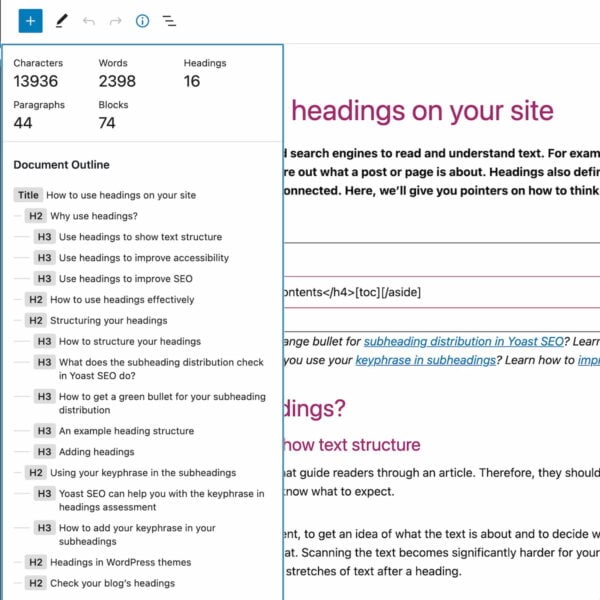
The block editor has a Document Outline feature that gives you an overview of the heading structure
Please read this article on headings and SEO to learn why proper titles are essential. In addition, you can read our article about the heading structure for your blog — from which a lot applies to non-blog WordPress sites.
2.3.5. Optimize your meta description
We don’t recommend automated descriptions
Some themes and plugins try to produce descriptions automatically, by
taking the first sentence or so of a post. This is a clever shortcut,
but it rarely produces good descriptions. The first sentence of a post
is often introductory information, which doesn’t provide a great summary
or an enticing advert!
The only well-written description is a handwritten one, and if you’re
thinking of auto-generating the meta description, you might as well not
do anything, and let the search engine pick and control the snippet.
NOTE:
Search engines may choose to ignore your meta description if they think
that it’s unsuitable for the page, or they might choose to show a custom
description from the page content if they think it’s a better fit.
There’s no way of forcing them to use your specific snippet.
Search engines primarily use a meta description
to describe your page in the search engine results, usually below your
page title. Tailoring and writing a descriptive meta description can
encourage users to click your results in the search engine, even if
you’re not necessarily ranking in the top position. It’s an advert and
your opportunity to impress.
Writing compelling, informative descriptions of your page content for every page
on your site is best practice and allows you to attract more visits.
While it might feel like a lot of work to craft descriptions for every
page and post, it’s worth the effort.
If you don’t provide a meta description, the search engine
will generally try to find the keyword searched for on your page and
automatically pick a string around that — and highlight the searched
phrase in bold on the results page. In some cases, Google will generate
its meta description for you.
Automatically generated snippets (whether by plugins or search
engines) are rarely as descriptive or as compelling as hand-written
ones. We recommend using the meta description field in the Yoast SEO
plugin to write a meta description. Make sure it entices the reader to
click through and make sure that it contains the focus keyword of your
post or page at least once.
2.3.6. Optimize your images and media
An often overlooked part of WordPress SEO is handling your images,
videos, and media content. To ensure that search engines can understand
your images, you need to think about how you name and format your files.
Make sure to pick the correct format and optimize every image. Also,
try to see if you can use next-gen image formats like WebP — which
WordPress is starting to support. Writing descriptive accessible text
descriptions helps to make your images more understandable and can
improve your performance significantly. As an added benefit, you’re also
helping readers who rely on assistive technologies like screen readers.
Using the proper alt attributes for images and transcripts of videos are also something that we check in the content analysis functionality of our Yoast SEO plugin. We have a longer article on image SEO and one writing alt tags, which can give you more tips to fine-tune your image optimization!
In most cases, your post’s URL should probably contain your focus
keyphrase so that it’s obvious what your page is about from the link.
You should always try and keep your permalinks short, descriptive, and
clean — don’t put unnecessary words in for the sake of it!
Before you publish new posts or pages, you may also wish to consider removing ‘function words‘
from your permalink. These are words like “a”, “and”, and “the”. This
may make your permalinks more readable and easier to use or link to when
done carefully. Posts with incredibly long titles may benefit from this
approach.
We recommend being careful when changing permalinks for posts you
have already published. If people have already linked to your pages,
changing the URLs may make a mess. Even though WordPress will sometimes
redirect users to the new location (the redirect manager in Yoast SEO Premium handles this automatically and more reliably), changing URLs can impact performance.
2.3.3. Optimize your page title
Each page’s title — the contents of the HTML <title>
tag — can be one of the most critical factors for ranking well in
search results. Not only is it the literal title of the tab or browser
window, but it’s also the first line people see in the search results.
It describes what your page is or is about and acts as an advert that
encourages users to click.
On many websites, the default structure for posts and pages isn’t
necessarily the most optimal approach for SEO. An title like “My blog »
Cooking » Carbonara recipe” isn’t as compelling as “My 20-minute delicious carbonara recipe | My Blog”.
You must think about the structure of your titles and the content of the title on each page. Typically, it’s worth considering that:
Search engines may put more weight on the early words, so getting
your keywords near the start of the title might make you more likely to
rank well.
People scanning result pages see the early words first. If your
keywords are at the start of your listing, your page is more likely to
get clicked on.
Keep in mind that search engines can rewrite things like SEO titles
and meta descriptions if they think they can better describe your
content.
For more info on how to create enticing titles for your posts, read our article on crafting good titles for SEO.
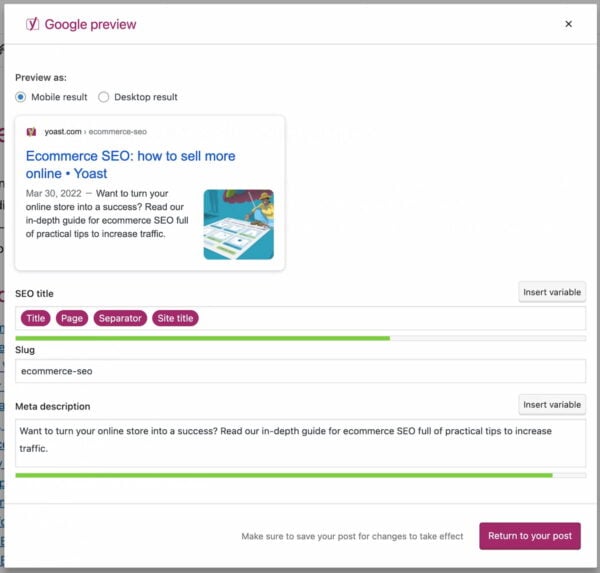
The
Google Preview in Yoast SEO gives you an idea of how your post will
look in search engines. Use it to make your content stand out!
Did you know? You can use Yoast SEO to structure your SEO titles! You
can control the default structure of your page titles and descriptions
in your Yoast SEO plugin. There are two parts of the plugin that control
these. First, as soon as you install and activate the plugin, you get a ‘Yoast SEO’ section in your WordPress admin.
Navigate to the Yoast SEO settings, and click on one of the Content
Types or Categories and Tags. You can set a so-called Title Template and
meta description templates for each post type and taxonomy. For
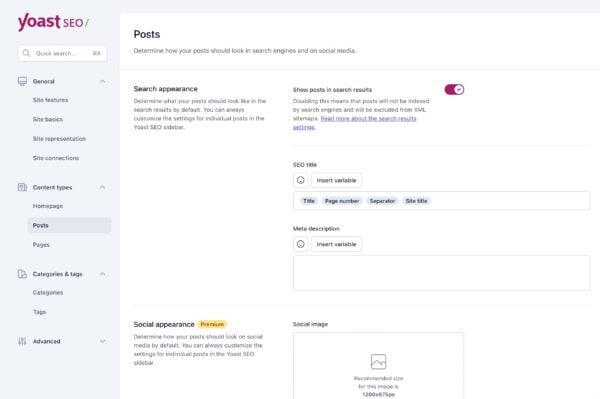
example, for posts on our site, this looks like this:
You can set templates in the Yoast SEO settings
This allows you to use components and variables to control how your
page titles should behave by default. Of course, these can be overridden
on a page-by-page basis. For example, in the image above, you can see
how we’re automatically grabbing elements like the page’s title to stop
us from manually writing titles from scratch for every page.
You can use all sorts of variables in the SEO titles and meta description, and they’re all listed and explained in the help tab on the page.
For advanced users, there are some additional cool features. For instance, you can use cf_<custom field name> to drop in any custom field — either from a post meta value or a user meta value.
NOTE: When you use these templates, check that your title tags behave
as expected when viewed on the site. If they don’t, you may have a
problem with how your theme is built, and you might need to check the
“Force rewrite” checkbox in our options. You can also follow these instructions to modify your templates.
WordPress SEO also means your site should provide the best content on your chosen subject. People are looking for engaging, authoritative articles and trustworthy answers to their questions. Writing high-quality content
for your WordPress site begins with your unique ideas or distinctive
take on a particular topic. But it also means presenting these ideas in a
well-structured and accessible manner. This will help you attract the
audience you’re looking for and keep them engaged.
2.1. Research what your users want and need
Curious about the WordPress block editor?
Still haven’t tried the new block editor? Tried, but found it confusing? We’re here to help: our freeWordPress block editor course explains everything you need to know!
Before writing your content, you should think about what search terms
you want to be found for. Then, you should optimize every page or post
for a specific keyphrase.
But how can you determine what keyphrase you want to be found for? To find out, you need to do keyword research.
In this process, you should ask yourself questions: what terms do I
want to rank for? How realistic is it that I can rank for these terms?
Imagine you have a baking blog, and you’re passionate about sharing
your favorite recipes and baking techniques. Optimizing a post for a
term like [best cake recipe] isn’t a realistic goal because it’s a very
general term. There’s a lot of competition for such general terms.
Instead, it would help if you thought about finding your niche. This niche could be [healthy, low-sugar cake recipes] or[French patisserie you can make at home].
Within a niche, you can become an expert. Your expertise
enables you to create content that goes beyond that of your
competitors. You can go deeper than others or shed light on different
angles of the same topic. For this, you’ll want to focus on long-tail
keyphrases. For example, a long-tail keyphrase might be [how to make a
low-calorie vegan blueberry cheesecake]. A keyphrase like this is more
specific and easier to rank for. Also, it’ll be more suitable for your
particular niche topic.
Focus on search intent
It’s also essential to think about what your audience wants to achieve by searching for a specific term. This is called search intent.
For example, they could be looking for the answer to a particular
question, and you can provide the necessary information. Or they might
want to buy a specific product that you can offer them. Think about the
needs of your visitors and address them by creating content accordingly.
Need a hand doing keyword research properly? Our Keyword research training can help. This course is part of our Yoast SEO academy. You’ll get access to Academy for free once you sign up for Yoast SEO Premium — two essential products for one low price.
2.2. Write great content for your users
After you’ve done your keyword research and know the topics you want to write about, you need to get to the actual writing.
Most of the time, that’s easier said than done. To get from an idea to a
great piece of content, most likely, you’ll have to follow a cycle of drafting, writing, editing, and rewriting.
Your first draft can be an outline of your structure. You don’t have
to write out everything in perfect prose at this point, but make sure
that you follow a logical structure. Most pieces will include an introduction, your main points of argument, and a conclusion. Of course, this will vary per genre – a recipe will have a completely different structure.
You can further flesh out the points in the writing phase, where you
try to develop a first complete version of your text. Finally, you
should check whether your piece is engaging and easy to read in the
editing phase. You might be an expert on your topic, but your audience
probably isn’t (yet). So try to make your writing as accessible as
possible. Readability is essential. The readability analysis in Yoast SEO helps you improve your writing.
Beginners can find writing hard, but there’s help around the corner.
When in doubt, it’s always best to ask a friend or colleague for some
feedback. Another helpful trick is to read your text out loud to
yourself. You can even let your computer speak it. It will give you a
better idea of whether everything flows nicely.
2.3. Optimize your individual posts and pages
When writing or editing your post for your WordPress site, you need
to pay special attention to some elements to make it SEO-friendly. These
elements include your subheadings, your SEO title, and your meta
description — all of these need to reflect the topic of the specific
post.
Don’t forget, SEO-friendly doesn’t just mean that it’s easy for a
search engine to grasp a page’s topic. More importantly, it means that
your visitors can get the gist of your page at a single glance.
Your meta description
and your SEO title might be a deciding factor for whether visitors
click on your page in the search results in the first place. And once
they’ve visited your site, elements like subheadings can be critical for
visitors to decide whether they want to stay on your site.
2.3.1. Set your focus keyphrase(s)
One important rule is not to use a focus keyphrase on more than one page.
Otherwise, you might end up cannibalizing yourself. Most of the time,
you don’t want to rank for multiple pages on the same keyphrase because
it means that you’re setting yourself up as your competition.
It’s also essential to include the focus keyphrase in crucial
elements of your post, such as the SEO title, the introduction, your
subheadings, and your meta description. All of these elements are
signals for what your post is about. Since your focus keyphrase is, in
fact, the main topic of your page, it’s a logical consequence that you
should make sure this topic is reflected in all of these elements.
The same logic holds for your text overall: you need to make sure
that you don’t stray off-topic; if you stay on-topic, it should follow
naturally that you use your keyphrase multiple times throughout your
text. But avoid stuffing your writing with your keyphrase. If you find
it hard to include your keyphrase in your text a sufficient number of
times, it might be a sign that you should take a different approach to
the topic.
To avoid repetition, you can use synonyms and related keyphrases.
Synonyms mean the same or more or less the same as your keyphrase. An
example of this is the words film and movie. Search
engines will recognize that they have the same meaning, which you can
also check by looking at the search results: if you search for movie, film will also be highlighted in the results, and vice versa.
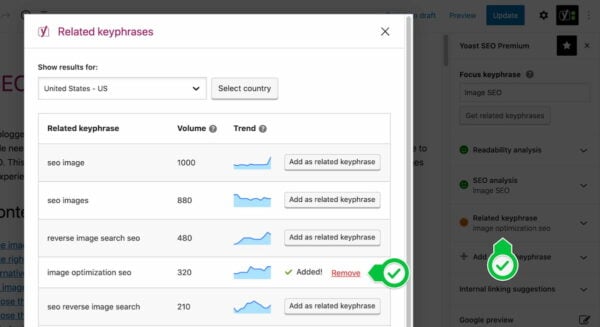
You can also use related keyphrases to optimize a single page for
similar, related terms. You can use these to give context to your
keyphrase. For example, if your keyphrase is [pumpkin soup], your
related keyphrase might be [winter weeknight dinners]. This second,
broader term gives additional information about your topic. It can also
create coherence by establishing a link to similar pages on your post.